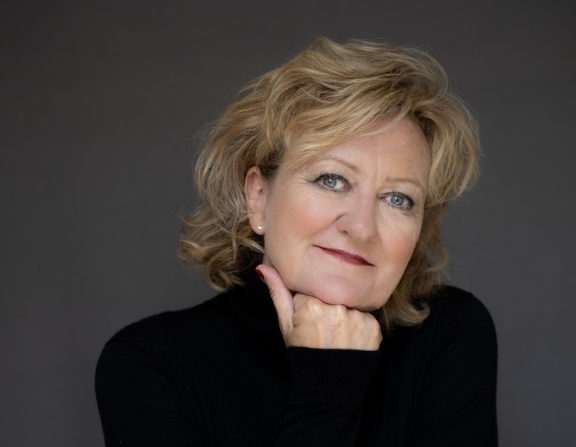
At Rijeka’s Vrisak festival, one of Norway’s most widely read writers, Trude Teige, presented the newly translated novel When Grandma Danced in the Rain (Petrine knjige, translated by Anja Majnarić), a book that explores, on several levels, questions of silence, suppression, repression, and all that remains unspoken.
A black-and-white photograph of her grandmother with an unknown German soldier, discovered by the protagonist Juni at the bottom of a box in a wardrobe, in a sense draws back the curtain on a story that has until then remained unknown to her. It is a story that enters the cracks within a family before opening onto wider social and collective traumas and horrors, because, as Juni’s grandmother Tekla says at one point, history sticks to a person. Despite the painful and difficult historical subject matter, Teige weaves a web of tenderness and solidarity along the edges of those fractures, attempting in this way to mend them and guide us towards the possibility of hope.
We spoke with the author about inherited silences and family secrets, women who have remained at the margins of wartime history, the meeting point between the documented and the fictional, and stories that have been waiting for decades to be told.
As far as I know, this is your first visit to Croatia, and When Grandma Danced in the Rain is also being introduced to Croatian readers for the first time. Could you begin by telling us a little about yourself in your own words, and what it means to you to meet a new readership?
I live outside Oslo with my husband and our dog, and I have three grown-up children. I worked as a radio and TV journalist for almost 30 years. For 22 years I was a news anchor, political reporter and debate moderator, and I had my own talk show on TV 2. At the same time, I was writing novels, and twelve years ago I decided to devote myself full-time to my career as an author. I have written five historical novels and eight crime novels, as well as a few other non-fiction books. When Grandma Danced in the Rain is the first novel in a trilogy; the books can be read independently of each other, while also being connected.
I know many people who have been to Croatia and have spoken warmly about the country. Now I understand why. And yesterday, while I was sitting and working at the hotel, I received a message from a neighbour I had when I was growing up. She was flying to Dubrovnik today and comes here twice a year. She was going to buy the “Grandma book” in Croatian for her friends and take it home to Norway, where the couple looking after their house while they are here are also from Croatia!
I am absolutely delighted that the books are now out here in this country!
Tekla, Lilla and Juni – grandmother, mother and daughter – are three generations of women whose lives have, in different ways, been shaped by silence. The novel unfolds through two parallel narrative strands, following Tekla in the past and Juni in the present. How did you arrive at this structure, and what did it allow you to reveal by weaving their stories together?
At its deepest level, this is a novel about how silence can mark a family for several generations, and how the grandmother’s trauma and her great secret help define the relationship between the three women. I believe trauma can be inherited, even when one does not know about one’s parents’ or grandparents’ experiences and painful life stories. Research has even been conducted on this, and genetic changes have been found in the descendants of traumatised people.
Children are sensitive; they notice when adults are carrying something. Juni does too. There is something unspoken, something that grates between her mother and grandmother, and it often makes her sad. As an adult, it is liberating for her to know what it was about, even though it is also deeply painful when secrets are revealed.
At first, the image of the grandmother dancing in the rain seems like a beautiful, almost curious memory from Juni’s childhood. But as Tekla’s past is gradually revealed, the meaning of that image begins to shift. It becomes increasingly clear that language itself reaches a limit, a point beyond which certain experiences can no longer be put into words. Why did you choose dancing in the rain as such a central motif?
While I was writing the novel, I received a text message from my eldest daughter, who was studying literary history at university. She was reading In Search of Lost Time by Marcel Proust, and came across a passage in which an elderly woman dances in the rain in the garden. My daughter wrote: “That will be you, Mum, when you are old.” I am known for being very fond of rain, and I often put on my running clothes and go out for a run when it rains. The moment I received the message from my daughter, I had the title. Then began the work of developing her relationship with the rain. I think her line, “Rain is life’s applause,” says a great deal, especially at the end of the novel. And it is a sentence that is often quoted, almost like a tagline for my authorship.
To me, the sentence symbolises the ability to fight, survive and rediscover joy in life after everything has fallen completely apart.
The novel was partly inspired by your encounter with Anna Deichmann, a Norwegian woman who fell in love with a German soldier during the war, married him and later left Norway with him. How did you balance this real-life story with the demands of fiction?
Meeting Anna left an indelible impression on me. The novel is not about her, although elements of her experiences are included. What Anna told me is not found in history books, and we know almost nothing about the women who married German soldiers in 1945 and left with them for Germany. I spent several years uncovering these women's stories and conducting extensive research into what they left behind and what they encountered upon arriving in a war-torn Germany. The novel is inspired by many true stories and events. I place fragments of these within historically accurate settings and events, yet together they form my own fictional world and fictional protagonists.
The novel also seems to be grounded in extensive historical research. At what point did you feel that the facts had to give way to literature? The book opens with Virginia Woolf’s words: “Fiction is like a spider’s web, attached ever so lightly perhaps, but still attached to life at all four corners.” What was it that only fiction could express?
Anna died just three months after I met her. My original plan was to make a TV documentary about her. That became impossible, and I began thinking about a novel that would be about more than just her story.
Fiction can be an escape, a journey to places you will never travel to, to other cultures, to another time, and an experience of other ways of thinking that I do not believe other forms of storytelling can offer in quite the same way.
Literature can also create recognition with a depth that cannot be found anywhere else. It can also create a form of pleasure that is profound and multifaceted. A good book can feel like an embrace, a warm hug, a cold shoulder or a blow from a fist. But perhaps most importantly, literature can broaden our horizons, deepen our understanding of other people, create empathy and make us wiser. And that is exactly what we need in our time.
To stay with the subject of silence, many readers have learned through this novel that Norwegian women who married German soldiers were interned, stripped of their citizenship and expelled from the country. At the same time, the book has also been extraordinarily successful in Germany, where many aspects of the Second World War remained unspoken for decades. Were you surprised by the responses of Norwegian and German readers?
I am, of course, surprised by the enormous success, but I felt certain that the story would make an impression on many readers because the subject matter is quite extraordinary. And the feedback—both in Norway and Germany—has been very similar. I believe the reason for this success is that I have lifted the veil on a part of war history that has gone untold and undiscussed. My project has been to uncover precisely what is unknown to most people. And the least known aspect is the stories of the women. In many countries, I have met readers who ask, "Did this really happen?" They know it is a novel, yet they also learn something about the truth. I suppose I could say that the novel is true within the boundaries of fiction.
I would like to add that, while I do write about truly harrowing events and fates, the book likely wouldn't have been a success had it not been just as much about strength, hope, survival, and human love.
You have spoken in interviews about how the history of the Second World War was largely written by men and, as a result, tended to place male bodies and male experiences at its centre. In this novel, you bring attention to the often invisible suffering and trauma endured by women and their bodies, but also to female friendship, solidarity and care through characters such as Sonja, Elsie and her daughter Anja. Why was it important to you to bring those experiences to the foreground?
What does it mean to be Norwegian or Croatian, and what values define us? Wars are highly defining for a nation’s identity, at least in Norway. To understand that identity, we need the whole story. If we only know men’s war stories, we only know half of a nation’s history, and we do not fully know our own identity.
Before devoting yourself fully to literature, you worked as a journalist for many years, and you have said that researching historical novels can sometimes take years. When you write a book like this, how do the journalist and the novelist in you work together?
My writing is largely driven by my background as a journalist, and this is especially useful in my research. I only begin writing a novel when I have the feeling that I am on the trail of something important and get that shiver down my spine, similar to the feeling I used to get as a political journalist when I sensed that politicians were hiding something.
This novel became the first part of a trilogy that explores other lesser-known chapters of wartime history, from the Japanese internment camps in Java in Grandpa Breathed With the Waves to the forced labour of women in Norway in Until We Meet Again By the Sea. When did you realise that these stories needed to become a trilogy? Are there other forgotten or overlooked stories from the past that you would still like to explore in fiction?
I had no plans for a trilogy when I wrote „When Grandma Danced in the Rain“. But afterwards, I began thinking about her Norwegian husband, whom she married after the war. I liked him very much, yet the only thing I had written about him was that he had been a sailor during the war. Once again, I started looking for untold war stories and discovered, to my surprise, that Norwegian citizens had been held in horrific Japanese concentration camps in Southeast Asia during the war, alongside hundreds of thousands of others from across Europe. Initially, I hadn't wanted to write about a man's wartime experiences. But then I found that there were many women and children among those prisoners. So, in the book about the grandfather, a female character also plays a leading role. She is the grandfather's first love—before he meets Tekla.
During the war, there were over 100,000 prisoners of war and forced laborers in Norway. Many of them were from Yugoslavia. We know little about them, and when I discovered that there were a few women among them, it piqued my curiosity. It was yet another untold story about women, and it became a third book. One of the main characters is a Ukrainian woman. Another is Tekla’s childhood friend; these women—who make different choices with profound consequences and end up on opposing sides—become figures of great importance to one another when life becomes almost unbearable.
Finally, returning to the question of memory: the novel was first published in 2015. After travelling with this book for so many years, how do you see it now when you look back at it?
I pinch myself every day! It has been an adventure. "Grandmother" has taken me to places I otherwise never would have visited. But the most amazing thing is all the encounters with readers who have been inspired to discover the truth about their own family histories and the histories of women and war in their countries.
Let me add that I have written many other books, too, and at the moment I travel around Norway with my latest crime novel.